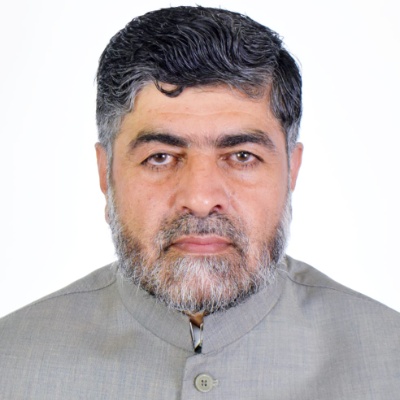
Dr. Atta Ur Rahman
Professor
Department of Geography and Geomatics | University of Peshawar
Academic Qualification
Professional Experience in Teaching and Research
2020 to 2024: Chairman, Department of Geography and Geomatics, University of Peshawar-Pakistan
2022 to Date: Professor, Department of Geography and Geomatics, University of Peshawar-Pakistan
2013 to 2022: Associate Professor, Department of Geography, University of Peshawar-Pakistan
2009 - 2013: Assistant Professor, Institute of Geography, Urban and Regional Planning, University of Peshawar-Pakistan
2002 - 2009: Lecturer, Department of Geography, Urban and Regional Planning, University of Peshawar-Pakistan
1998 - 2002: Lecturer in Geography, Govt. Post Graduate College, Nowshera, Education Department, Govt. of NWFP.
Member of Professional and Academic Bodies
Professor, Department of Geography and Geomatics, University of Peshawar, Pakistan
Convener, National Curriculum Review Committee on “GIS and Remote Sensing”, Pakistan
Convener, National Curriculum Review Committee on “Geography”, Pakistan
Secretary, National Curriculum Review Committee on “Disaster Management”, Pakistan
President, Pakistan Geographical Association
Member Senate, University of Chitral
Member, Steering Committee, Alliance of National Science Organizations for Disaster Risk Reduction
Convener, National Curriculum Review Committee on “GIS and Remote Sensing”, Pakistan
Member, Digital Belt and Road Science Program, Chinese Academy of Sciences
Member, Integrated Research on Disaster Risk, International Science Council
Member, Forewarn Expert Advisory Group, Start Network, Pakistan
Member, International Forum of Big Data for SDGs (FBAS, CAS): DRR Working Group
Member, Advisory council “Center for Sustainable Development” UETP, Pakistan
Member, Population Association of Pakistan, Pakistan
Member, Board of Faculty, Shaheed Benazir Bhutto Women University, Peshawar
Co-Convener, Advanced Studies and Research Board, Sub-Committee-II, University of Peshawar
Member Senate, University of Chitral, Pakistan
Member, Board of Studies, Department of Geography, Bahawudin Zakria University, Multan
Member, Board of Faculty, University of Engineering and Technology, Peshawar
Member, Board of Faculty, Shaheed Benazir Bhutto Women University, Peshawar
Member, Board of Studies, Department of Geography, University of Haripur
Member, Board of Studies, Department of Geography and Regional Planning, University of Baluchistan, Quetta
Member, Board of Studies, Department of Geography, Government College University Faisalabad
Member, Graduate Studies Committee, Department of Botany, University of Peshawar
Co-Convener, Advanced Studies and Research Board (Sub-Committee II), University of Peshawar
Convener, Graduate Studies Committee, Department of Geography, University of Peshawar
Member, Graduate Studies Committee, Department of Botany, University of Peshawar
Member, Academic Council, University of Peshawar
Member, Academic Council, University of Engineering and Technology, Peshawar
Member, Board of Faculty, University of Engineering and Technology, Peshawar
Convener, Board of Studies, Department of Geography, University of Peshawar
Convener, Graduate Studies Committee, Department of Geography, University of Peshawar
Convener, Department Semester Committee, Department of Geography, University of Peshawar
Convener, Board of Studies, Department of Geography, Benazir Bhotto Women University Peshawar
Member, Board of Studies, Department of Geography, University of Haripur
Member, Board of Studies, Urban Infrastructure Planning and Engineering, University of Engineering and Technology, Peshawar
Member, Board of Studies, Department of Geography, University of Baluchistan, Quetta
Member, Board of Studies, Department of Geography, University of the Punjab, Lahore
Member, Board of Studies, Department of Geography, Government College University Faisalabad
Coordinator, Geomatics (GIS/Remote Sensing) Program, Department of Geography, University of Peshawar, Pakistan
Coordinator, Climate Change Science Program, Department of Geography, University of Peshawar, Pakistan
Research Interest and Academic Endeavors
RESEARCH INTERESTS
Prof. Dr. Atta-ur-Rahman is serving as a Professor Department of Geography and Geomatics (GIS and Remote Sensing), University of Peshawar, Pakistan and President, Pakistan Geographical Association (PGA). He is holding degrees of Bachelor of Sciences in Bio-Geo-Chemistry, Master of Science in “Geography” with distinction, Master of Science in “Urban & Regional Planning” with Gold Medal, MPhil in “Applied Geomorphology”, Post-Graduate Dip in GIS & Remote Sensing, PhD in “Environmental Geography” and Post Doc in “Flood Risk Modelling” from Kyoto University, Japan. He is regularly publishing in prestigious journals with a good share of publications in impact factor. He has over 170 publications, with a majority of publications in the field of climate change, hydro-meteorological, Agricultural Geography and Disaster Risk Management. He has supervised and produced 40 MS/MPhil and 12 PhDs.
ACADEMIC ENDEAVOURS AND SERVICES
Prof. Dr. Atta-ur-Rahman has extensive experience in research projects and completed several projects, which were mainly focused on environmental assessment, social vulnerability, disaster risk, disaster resilience, multi-hazards vulnerability and risk assessment, climate change, mapping Atlas, development plans and rehabilitation. He is a member of the National curriculum committee and incorporated the latest techniques and analytical methodologies in curricula at various levels. He is also Secretary, National Curriculum Review Committee on “Disaster Management. Furthermore, he has a longstanding experience of collaborative and research linkages, Faculty Exchange and Professional Networking with international organizations/institutions. He is interested in conducting collaborative and cross cutting multi-disciplinary research. He is also editor and member of editorial boards of prestigious national and international Journals and reviewer of numerous research journals. He has an extensive experience of organizing conferences, workshops, exhibitions, seminars and also participated in numerous national and international conferences, workshops, seminars, exhibition and symposia as a resource person.
AWARDS AND HONOURS
2018 World Class Professor, Ministry of Science and Technology, Indonesia
2017- Award of best Member, Digital Belt And Road (DBAR) “Disaster”, China
2014 – Best paper award, Kyoto University Japan
2013 – HEC Post Doc Fellowship award, Higher Education Commission of Pakistan
2009 – Best Speaker award in International conference, Nepal
2005 - Best paper award, International Science Conference, University of Azad Jammu & Kashmir
1998- Gold medal, University of Peshawar
Monograph / Books Authored
MONOGRAPHS/ BOOKS AUTHORED
1. Shaw R, Rahman A, Surjan A, Parvin GA. (2016). Urban Disasters and Resilience in Asia. Elsevier, New York.
2. Rahman A, Khan AN, Shaw R. (2015). Disaster Risk Reduction Approaches in Pakistan. Springer, Tokyo
3. Rahman A. (2010). Ex Post Environmental Impact Assessment: A Regional Perspective. VDM Verlag Publishing co. Ltd Germany, ISBN 978-3-639-19563-7.
4. Rahman A. (2010). Disaster Risk Management: Flood Perspective. VDM Verlag Publishing Co. Ltd Germany, ISBN 978-3-639-29891-8, 192 Pages.
Research Publications
Research Publications
- Liu, Y., Wen, Q., Zhao, J., Ma, R., Rahman, A., & Tian, X. (2026). Scale-Constrained Synthetic Construction for Small-Sample Satellite Power Tower Damage Assessment under Cross-Scale Mismatch. Sensors 26(10), 3241.
- Jamal N., Rahman A. (2026) Effectiveness of flood forecasting and early warning system in the affected communities of Indus River Basin, Pakistan. Journal of Water and Climate Change, 17(4): 759-773
- Rahman, A., Amjad, O., Zia, H., Dawood, M., (2026) Spatio-Temporal Analysis of Land Use Land Cover Dynamics, Synergy of Land Surface Temperature and Snow Cover Fluctuations in Gilgit River Basin, North Pakistan. International Journal of Innovations in Science & Technology (IJIST), 8(2): 663-684
- Gul S., Rahman A., Shaw R. (2026) Empowering Women in Disaster Management and Climate Adaptation: Insights from a Cross-Sectional Study in Pakistan. In Bhattacharyya, M., Shaw R. (eds) Gender, Climate Change and Disaster Resilience. Springer.
- Iman, A., Rahman, A., (2026). Wildfire. In: Shaw, R. (eds) Encyclopedia of Disaster Risk Reduction. Springer, Singapore.
- Jamal N., Rahman A., (2026) Evaluating the effectiveness of flood forecasting and early warning system in the diverse topographic region of Indus River Basin, Pakistan using the SWOT approach. Discover Geoscience, 4: 110
- Khan, A., Yu B., Lei W. Rahman, A., (2026). Soil Erosion. In: Shaw, R. (eds) Encyclopedia of Disaster Risk Reduction. Springer, Singapore.
- Benardi, A. I., Rahman, A., Sumarmi, S., Suharini, E., Amelia, N., Sugiarto, A., Sejati, A. E., Ikhsan, F. A., Yametis, J. V. G. (2026) Improving disaster mitigation cognitive learning outcomes through vlognow and wordwall as interactive digital media in senior high school. Jurnal Pendidikan Geografi: Kajian, Teori, dan Praktek dalam Bidang Pendidikan dan Ilmu Geografi, 31(1): 12-22.
- Benardi, A. I., Rahman, A., Liesnoor Setyowati, D., Gustiyansyah Selebes, A., Gerar Yametis, J. V., Wijayanto, B., … Zulfi Al’Ghani , M. (2026). Public Perceptions on Land Use Change and Flood Incidence in the Kendal Watershed Area. Jurnal Geografi, 18(1), 16–35.
- Iman, A., Rahman A., Rahman G., (2025) Geospatial analysis of wildfire patterns and temporal trends in Kohat Division, Pakistan, using Remote Sensing and GIS. Ecological Questions 36(4), 65-81.
- Mehmood, H., Rahman A., & Nawaz, U. (2025) Machine learning as a tool for exploring impacts of climate change on hydrological extremes of Gilgit River Basin, Karakorum Mountains. GeoJournal 90 (04), 207
- Qazi, A. J, Qadir, I, Rahman, A. (2025) Floods and Flood Hazard Assessment in the Floodplain of River Swat, District Charsadda, Pakistan. International Journal of Innovations in Science & Technology, 07 (9S), 311-322
- Khan, F., Rahman, A., Manglore, U., Dilbar, S., (2025) Geospatial Nexus of Land Use Land Cover dynamics and Rapid Population Growth with Emphasis on Trend Prediction of Built-Up Areas in District Hangu, Pakistan. International Journal of Innovations in Science & Technology, 07 (9S), 157-173.
- Hashim, M., Rahman, A., Qasim, M., Farooq, M. U., Dawood, M., Nadeem, B., Muneer, S., (2025) Application of Geospatial Approaches for Evaluation of Urban Growth Pattern and Trend Prediction of Multan City, Pakistan. International Journal of Innovations in Science & Technology, 07 (9S), 108-120
- Mehmood, H., Rahman A. (2025) Temperature variability and trend analysis in the high-altitude Gilgit River Basin: a statistical assessment using Mann-Kendall and Sen’s slope methods’. International Journal Hydrology Science and Technology, 20(3): 339–357.
- Ambreen, H., & Rahman, A., (2025). Evaluating Spatio-temporal Dynamics in LULC and its Implications on Land Surface Temperature of Swat valley, Eastern Hindukush. International Journal of Engineering and Geosciences, 10(3), 495-503
- Jamal. N., Rahman, A. (2025) Role of Flood Forecasting and Early Warning System in Flood Management: A Study of 2010 Flood in Swat Valley, Pakistan. International Journal of Innovation, Science and Technology (IJIST), 7(3), 2013-2028
- Jamal, N., Rahman A. (2025) Evaluation of Flood Forecasting, Early Warning System and its Role in Flood Management in Indus Basin, Pakistan. Annual Methodological Archive Research Review, 3(7), 274-290
- Tufail M., Nasir M.J., Rahman A., Kakakhel S.I., Ashraf M., Tariq A., (2025) Community perceptions of potable water quality and public health implications in flood-affected areas of Nowshera District, Pakistan. World Development Perspectives, 38, 1-15
- Nadeem, B., Rahman, A., Dawood, M. (2025). Modelling Rainfall Variability, Trend and Anomaly in Jhelum River Basin, Western Himalaya. Carpathian Journal of Earth and Environmental Sciences, 20(2), 295-306.
- Ahmed Z., Nihei T., Rahman, A. (2025) Spatial Analysis of Flood Susceptibility Using Frequency Ratio in Shigar Valley, North Pakistan. Transportation Research Procedia, 84: 35-42.
- Benardi, A. I., Sumarmi, S., Bachri, S., Suharini, E., Rahman, A., Sriyono, Amin S., Yametis J. V. G. (2025) Student’s disaster preparedness of Merapi Volcano, Indonesia using Learning Simulation Virtual Reality (LSVR) Model. Jurnal Pendidikan Geografi: Kajian, Teori, dan Praktek dalam Bidang Pendidikan dan Ilmu Geografi, 30(1), 2025, 37-55.
- Tufail M., Nasir MJ., Rahman A., Kakakhel S.I., Tariq A. (2025) A geospatial assessment of the resilience of municipal water supply to flooding in Nowshera District, Pakistan. HydroResearch, 8: 89-98.
- Gul, S., Rahman, A., Shaw, R. (2025). Gender-Focused Social Capital and Community Actions to Mitigate Flood Risks in Pakistan. In: Abedin, M.A., Parvin, G.A., Takashino, N., Shaw, R. (eds) Climate Crisis in South and East Asia. Sustainability Solutions. Springer, Cham. https://doi.org/10.1007/978-3-032-01012-4_7
- Ambreen, H., Rahman, A. (2025). Snowfall Hazard. In: Shaw, R. (eds) Encyclopedia of Disaster Risk Reduction. Springer, Singapore. https://doi.org/10.1007/978-981-97-4547-0_264-1
- Rahman M., Rahman H., Rahman A., Shaw R. (2025) Disaster Management Law in Pakistan. In: Cui Y., Shaw R., (eds) Disaster Law: Implications to governance and implementation. Springer, Singapore.
- Rahman, H., Khan, A., Rahman, A., Shaw, R. (2024). Spatio-Temporal Dynamics of Land Use Land Cover and Its Impact on Flood-Prone Drainage Basin of River Swat, Eastern Hindukush. In: Mazumder, R., Shaw, R. (eds) Surface Environments and Human Interactions. Springer, Singapore.
- Nadeem, B., Rahman, A., Dawood, M., Kashif, M., Hashim, M. (2024) Spatio–Temporal Evaluation of Temperature Variability, Trend and Pattern in Jhelum River Basin, Western Himalaya. OEconomia, 7(2), 39-54.
- Yasir, Q. M., Zhang, Z., Ren, J., Wang, G., Naveed, M., Jahangir, Z., & Rahman, A. (2024). Spectral index for estimating leaf water content across diverse plant species using multiple viewing angles. Journal of Applied Remote Sensing, 18(4), 042603-042603
- Khan M. A, Rahman, A., Khan. Z, Sultan. Z, Marwat. F, Naz. T, Zahid. B. (2024). Evaluating and Predicting the Land Use Land Cover Changes and its Impact on Land Surface Temperature using CA-Markov model: A study of District Mardan, Pakistan. International Journal of Innovations in Science & Technology, 6(6S), 352–372.
- Marwat. F, Rahman. A, Manglore. U, Naz. T, Khan. Z, Zahid. B, Khan. A, Dilbar. S. (2024). Quantifying the Impact of Chashma Right Bank Irrigation Project on the Land use Dynamics and Cropping Pattern of Arid Region, Pakistan. International Journal of Innovations in Science & Technology, 6(6), 125–138.
- Khan, A., Rahman, A. (2024) Spatial analysis and extent of soil erosion risk using the RUSLE approach in the Swat River Basin, Eastern Hindukush. Applied Geomatics, 16(2), 1-16.
- Nasir M., Samiullah., Rahman A, Shah F., Ali Z., Iqbal S., (2024) Unveiling the Evolving Dynamics of Mountain Pastoralism at various altitudinal zones of Upper Swat Valley, Pakistan. Migration Letters, 21(S11): 56-71
- Manglore, U., Rahman, A., Marwat, F., Naz, T., Dilbar, S., & Khan, F. (2024). Geospatial analysis of flood causes and extent of flood damages in Swat Valley, North Pakistan. Natural and Applied Sciences International Journal (NASIJ), 5(1), 130–153
- Qasim M., Rahman A., Nihei T., Ahmed Z.. (2024). Latent Factors of Sustainable Tourism Practices and Green Hospitality Measures in Gilgit Baltistan, North Pakistan. Proceedings of the Pakistan Academy of Sciences: A. Physical and Computational Sciences, 61(1), 1–10.
- Khan SM, Rahman A, Ali M, Alshehri F, Shahab M, Ullah S. (2024) Pixel-Based Spatio-Statistical Analysis of Landslide Probability in Humid and Seismically Active Areas of Himalaya and Hindukush. Sustainability, 16(9):3556
- Qasim M., Rahman A., Nihei T., Ahmed Z. (2024). Latent Factors of Sustainable Tourism Practices and Green Hospitality Measures in Gilgit Baltistan, North Pakistan. Proceedings of the Pakistan Academy of Sciences: A. Physical and Computational Sciences, 61(1), 1-15.
- Findayani, A., Hayati, R., Amrullah, M. F., & Rahman, A. (2024). Towards a Resilient City: Analyzing Semarang Preparedness in Facing Disaster Related to Climate Change, Indonesia. Jambura Geo Education Journal, 5(1), 1-13
- Dawood, M., Rahman A., Rahman G., Nadeem B., Miandad M. (2024) Geo‑statistical analysis of climatic variability and trend detection in the Hindu Kush region, North Pakistan. Environmental Monitoring and Assessment, 196(4), 1-16
- Hashim M., Rahman A., Nadeem B., Aziz F., Dawood M., Qasim M., Farooq MU., Muneer S., (2024) Spatio-Temporal Analysis of Land Use Land Cover Changes and Spectral Normalized Difference Indices in Multan City, Pakistan. Al-Qantara, 9 (4), 685-698.
- Farooq, M. U., Rahman, A., Qasim M., Hashim M., Batool, S., (2023) Evaluation of Physical Expansion of Built Environment in District Sargodha (Pakistan). Journal of Asian Development Studies, 12 (3), 1223-1234.
- Shah I. A., Muhammad Z., Khan H., Ullah R., Rahman A. (2023) Spatiotemporal variation in the vegetation cover of Peshawar Basin in response to climate change. Environmental Monitoring and Assessment, 195, 1474:1-18
- Farooq M U., Rahman A., Qasim M., Hashim M., Batool S.. (2023). Monitoring the Impact of Built-up Area Expansion on Agricultural Land of District Sargodha, Pakistan. Central European Management Journal, 31(4), 285–296
- Malik, F., Khan, A. N., Rahman, A., Iqbal, S., & Nawaz, M. A. (2023). Extent and Evaluation of Factors Causing Flash Floods in Watalai Khwar, District Bajaur, Pakistan. CARC Research in Social Sciences, 2(3), 141–147.
- Naz. T, Rahman. A, Uzma, Marwat. F. (2023) Geospatial Analysis of Land Fragmentation and Its Impact on Land Use of District Peshawar, Pakistan. International Journal of Innovations in Science & Technology, 5(3), 252–269.
- Hashim, M., Rahman, A., Qasim, M., Farooq, M. U., Muneer, S., & Ahmed, Z. (2023). The spatio-temporal analysis of land use land cover changes in Multan city, Pakistan. Natural and Applied Sciences International Journal (NASIJ), 4(1), 120–134.
- Hashim M., Rahman A., Qasim M., Farooq MU., Nadeem B., Muneer S., (2023) Determination Of Demographic Change And Urban Settlement Pattern In Multan City, Pakistan. Journal of Positive School Psychology, 7(6), 1243-1253
- Ullah W, Karim A, Ullah S, Rahman A, Bibi T, Wang G, Ullah S, Bhatti AS, Ali G, Abbas A, Hagan DFT, Nooni IK, Zhu C and Hussain A (2023), An increasing trend in daily monsoon precipitation extreme indices over Pakistan and its relationship with atmospheric circulations. Frontiers in Environmental Sciences, 11:1228817.
- Khan A., Rahman A., Mahmood S. (2023) Spatial estimation of soil erosion risk using RUSLE model in District Swat, Eastern Hindu Kush, Pakistan. Journal of Water and Climate Change, 14(6): 1881–1899
- Benardi A. I., Sumarmi., Budijanto., Bachri S., Rahman A., Wulandari F. (2023) Disaster Preparedness in Proximity of Merapi Volcano, Indonesia: Is There Any Relationship in Knowledge and Attitude of Senior High School Students?. International Journal of Safety and Security Engineering, 13 (2): 245-254
- Khan Z. and Rahman A. (2023) Analysis of land use land cover and its impact on extent of soil erosion in Chitral River Basin, Hindu Kush. Pakistan. Pakistan Geographical Review, 78(1): 64-81
- Qasim M., Rahman A., Ahmed Z., Hashim M., Farooq M. U. (2023) Perception of Tourists towards Sustainable Tourism Development and Green Hospitality Management in Gilgit Baltistan. Journal of Positive School Psychology, 7(2), 1074-1092
- Siddique, F., Rahman, A. (2023). Genesis and spatio-temporal analysis of glacial lakes in the peri-glacial environment of Western Himalayas. International Journal of Engineering and Geosciences, 8 (2), 154-164
- Qasim M., Rahman A (2022) Spatio–Temporal Analysis of Tourism Development and Hospitality Management in Gilgit Baltistan, Pakistan. Pakistan Geographical Review, 77 (2), 106-120
- Khan S. M., Rahman A., Ali M. (2022) Extent and evaluation of landslide probability, triggering factors and model validation in sub-humid and seismically active area of district Shangla, eastern Hindukush. Pakistan Geographical Review, 77(2) 261-294
- Qasim, M., Rahman, A. (2022). Trends and Patterns of Temporal Tourism Growth in Gilgit Baltistan Region, Pakistan. Journal of Development and Social Sciences, 3(3), 524-537
- Rahman, G., Rahman, A., Munawar, S., Moazzam, M. F. U., Dawood, M., Miandad, M., & Panezai, S. (2022). Trend analysis of historical and future precipitation projections over a diverse topographic region of Khyber Pakhtunkhwa using SDSM. Journal of Water and Climate Change, 13(11), 3792-3811.
- Qasim, M., Rahman A., Ahmed, Z. (2022). Adventure Tourism in Gilgit Baltistan Region: Opportunities, Trends and Destinations. Annals of Human and Social Sciences, 3(2), 44–54.
- Khan S. M., Rahman A., Ali M. (2022) Prediction Capability of Bivariate Statistical Model for the Evaluation of Landslide Probability in Sub-humid and Seismically Active Region of Azad Kashmir, Lesser Himalayas. The Nucleus 59 (3-4): 68-84
- Ali S., Rahman A., Ali S. (2022) Spatio-Temporal Expansion of Built-Up Areas and its Impact on Farmland and Food Security of Peshawar Valley, Pakistan. Sarhad Journal of Agriculture, 38,(4): 1260-1272
- Rahman G, Bacha AS, Ul Moazzam MF, Rahman A, Mahmood S, Almohamad H, Al Dughairi AA, Al-Mutiry M, Alrasheedi M and Abdo HG. (2022) Assessment of landslide susceptibility, exposure, vulnerability, and risk in Shahpur valley, Eastern Hindu Kush. Frontiers in Earth Science 10: 953627. doi: 10.3389/feart.2022.953627
- Ali, S., Rahman, A., Ali, S. (2022) Spatio-Temporal Analysis of Land Use Land Cover, Dynamics in Built-up Area and its Trend Predictions in Peshawar Vale, Pakistan. Review of Applied Management and Social Sciences, 5(2): 177-192.
- Khan, MBA., Rahman, R (2022). Extent and Evaluation of Flash Flood Resilience in Mountainous Communities of Daral and Chail Valleys, District Swat, Pakistan. Proceedings of the Pakistan Academy of Sciences: Part A (Physical and Computational Sciences), 59(1), 1–13.
- Ullah N., Rehman M.U., Ahmad B., Ali I., Younas M., Aslam M. S., Rahman A., Taheri E., Fatehizadeh A., Rezakazemi M. (2022) Assessment of heavy metals accumulation in agricultural soil, vegetables and associated health risks. PLoS ONE, 17(6): e0267719
- Khan MBA, Ali A, Ullah Z, Subhan G, Rahman A. (2022) Nexus of Tourism and Environmental Impact Assessment in Tehsil Bahrain, District Swat, Pakistan: Cross-Sectional Response and Perception Analysis. Pakistan Geographical Review, 77(1) 16-33
- Khan, A., Rahman A., Samiullah., Ayub M. (2022) Impact of soil sealing on the genesis of pluvial flood in Peshawar, Pakistan. Arabian Journal of Geosciences, 15(7), 1-15.
- Rahman G., Rahman A., Anwar M A., Dawood M., Miandad M., (2022) Spatio‑temporal analysis of climatic variability, trend detection, and drought assessment in Khyber Pakhtunkhwa, Pakistan. Arabian Journal of Geosciences, 15(1) 1-13
- Khan, A., Rahman A. (2021). Quantification of Soil Erosion by Integrating Geospatial and Revised Universal Soil Loss Equation in District Dir Lower, Pakistan. Proceedings of the Pakistan Academy of Sciences: B. Life and Environmental Sciences, 58(4), 17–28.
- Safdar Q., Rahman A. (2021) Estimation of Regional Drought Frequency and Spatial Extent in Pakistan Using Standardized Precipitation Index. Pakistan Geographical Review,76 (2), 330-347
- Ayub M., Rahman A., Samiullah., Khan A. (2021) Extent and evaluation of flood resilience in Muzaffarabad City, Azad Jammu and Kashmir, Pakistan. Journal of Himalayan Earth Sciences, 54(2), 14-27.
- Saeed, M., Li, H., Ullah, S., Rahman, A., Ali, A., Khan, R., Hassan, W., Munir, I., Alam, S., (2021) Flood Hazard Zonation Using an Artificial Neural Network Model: A Case Study of Kabul River Basin, Pakistan. Sustainability, 13, 13953.
- Nasar-u-Minallah M., Zia S., Rahman A., Riaz O. (2021) Spatio-Temporal Analysis Of Urban Expansion And Future Growth Patterns Of Lahore, Pakistan. Geography, Environment, Sustainability, 14(3):41-53
- Dawood M., Rahman A., Mahmood S., Rahman G., Nazir S. (2021) Assessing the impact of climatic change on discharge in Swat river basin using fuzzy logic model. Arabian Journal of Geosciences 14(18): 1850
- Rahman G, Rahman A, Samiullah, Dawood M, Moazzam MFU, Lee BG (2021) Spatio-temporal characteristics of meteorological drought in Khyber Pakhtunkhwa, Pakistan. PLoS ONE 16(4): e0249718. doi:10.1371/journal.pone.0249718
- Mahmood, S., Sajjad, A. & Rahman, A. (2021) Causes and Damage analysis of 2010 flood disaster in district Muzaffar Garh, Pakistan. Natural Hazards, 106 (1): 1-15.
- Gul S., Rahman A., Samiullah, Khan R. A. (2020) Comparing the Agenda Setting Role of the Pakistani and Indian Newspapers in Disasters: A Case Study of the 2005 Kashmir Earthquake. Erdkunde, 74 (4), 301–316
- Zeeshan M., Khan Z. H., Rahman A. (2020) Impact of a Non-Dedicated U-Turn on Traffic: A Case Study of Phase-III Choke, Peshawar City, Pakistan. Pakistan Geographical Review, 75(2) 234-263.
- Muhammad Yasir, Q.; Rahman A.; Mahmood, S. (2020) Identification of Potential Sites for a Multi-Purpose Dam Using a Dam Suitability Stream Model. Water 2020, 12 (11), 3249.
- Jehan, I., Rahman A., Waqas, T. (2020). Assessment of meteorological drought and trend detection in Khyber Pakhtunkhwa, Pakistan. Arabian Journal of Geosciences 13 (16), 1-19
- Dawood, M., Rahman A., Ullah S., Mahmood S., Rahman G., Azam K. (2020) Spatio-Statistical analysis of rainfall fluctuation, anomaly and trend in the Hindu Kush region using ARIMA approach. Natural hazards, 101 (2), 449–464
- Samiullah, Khan MA, Rahman A, Gul S. (2019) The Impact of Urbanization on Land Use Dynamics in Peshawar City District, Pakistan: A Geoinformatic Approach. Proceedings of the Pakistan Academy of Sciences, 56 (3): 85-100
- Ali S., Rahman A., Ali S. (2019). Impact of Built Environment on Land use of Rapidly Growing Tehsil Takht Bhai, District Mardan. Sarhad Journal of Agriculture, 35 (3): 966-975
- Mahmood S., Rahman A., Shaw R. (2019). Spatial appraisal of flood risk assessment and evaluation using integrated hydro-probabilistic approach in Panjkora River Basin, Pakistan. Environmental Monitoring and Assessment, 191: 1-15
- Samiullah., Khan M A., Rahman A., Mahmood S. (2019). Evaluation of urban encroachment on farmland: A threat to urban agriculture in Peshawar city district, Pakistan. Erdkunde, 73 (2): 127-142
- Rahman A., Fang C. (2019). Appraisal of gaps and challenges in Sendai Framework for Disaster Risk Reduction priority 1 through the lens of science, technology and innovation. Progress in Disaster Science, 1(1): 25-29
- Anwar, S., F.A. Khan, Rahman A. (2019). Impact of Karakoram highway on land use and agricultural development of Gilgit-Baltistan, Pakistan. Sarhad Journal of Agriculture, 35(2): 417-431
- Rahman G., Rahman A., Ullah S., Miandad M., Collins A.E. (2019). Spatial analysis of landslide susceptibility using failure rate approach in the Hindu Kush region, Pakistan. Journal of Earth System Science, 128(3): 1-16
- Khan A, Rahman A, Samiullah , Ali M. (2019) Impact of Built environment on groundwater depletion in Peshawar, Pakistan. Journal of Himalayan Earth Sciences, 52(1): 86-105
- Mahmood S. and Rahman A. (2019) Flash flood susceptibility modeling using geo-morphometric and hydrological approaches in Panjkora Basin, Eastern Hindu Kush, Pakistan. Environmental Earth Sciences, 78(1): 16-34
- Mahmood S., Rahman A. (2019). Flash flood susceptibility modelling using geomorphometric approach in the Ushairy Basin, eastern Hindu Kush. Journal of Earth System Science, 128(4): 1-14
- Mahmood S, Rahman A, Sajjad A. (2019). Assessment of 2010 flood disaster causes and damages in district Muzaffargarh, Central Indus Basin, Pakistan. Environmental Earth Sciences, 78 (3) 1-5
- Khan, B., Khan, A. N., Qasim, S., & Rahman, A. (2019). Analysis of Human Perceptions and Adaptations to Flash Floods in Khyber Agency, FATA. Journal of Engineering and Applied Sciences, 38(1), 45-52.
- Dawood M, Rahman A, Samiullah, Rahman G, Azam K. (2018). Spatio-temporal analysis of temperature variability, trend, and magnitude in the Hindu Kush region using Monte Carlo and Sen’s slope approaches. Arabian Journal of Geosciences, 16(11): 1-15
- Samiullah, M.A. Khan and Rahman A. (2018). Spatial and temporal analysis of landholdings and farm fragmentation in Peshawar city district, Pakistan. Sarhad Journal of Agriculture, 34(3): 550-562.
- Moazzam, M F, Vansarochana, A., Rahman, A . (2018). Analysis of flood susceptibility and zonation for risk management using frequency ratio model in District Charsadda, Pakistan. International Journal of Environment and Geoinformatics, 5 (2), 140-153.
- Mahmood S, Sharif F, Rahman A, Khan A U. (2018). Analysis and Forecasting of Municipal Solid Waste in Nankana City using Geo-spatial Techniques. Environmental Monitoring and Assessment, 190(5): 261-278
- Rahman G, Rahman A, Samiullah, Dawood M. (2018). Spatial and temporal variation of rainfall and drought in Khyber Pakhtunkhwa Province of Pakistan during 1971–2015. Arabian Journal of Geosciences, 11(3): 11-46
- Khan K., Wahid S., Khan N. H., Shah S.U., Rahman A. Sarwar B., Ali N. (2018). Geospatial and Climatic Patterns Associated With the Distribution of Sand Fly (Diptera: Psychodidae) Vectors of Leishmaniasis in Pakistan. Journal of Medical Entomology, 55(2), 1–8.
- Rahman A., Shaw R., Azam K. (2017) Effectiveness of Disasters and Climate Change Risk Management in Pakistan: Lens of Science and Technology under the Sendai Framework. Abasyn Journal of Social Sciences, 10(6 Special Issue November): 8-18.
- Dawood M., Mahmood S., Rahman G., Rahman A. (2017) Impact of Rainfall Fluctuation on River Discharge In Hindu Kush Region, Pakistan. Abasyn Journal of Social Sciences, 10(6 Special Issue November): 246-259.
- Rahman G, Rahman A, Anwar MM, Ahmed M, Ashraf M, Zafar U. (2017). Socio-Economic Damages caused by the 2014 Flood in Punjab Province, Pakistan. Proceedings of the Pakistan academy of sciences, 54 (4): 365–374.
- Rahman G, Rahman A, Samiullah, Collins AE. (2017). Geospatial Analysis of Landslide Susceptibility and Zonation in Shahpur Valley, Eastern Hindu Kush using Frequency Ratio Model. Proceedings of the Pakistan academy of sciences, 54(3): 149–163
- Fang C., Rajib Shaw R., Abedin M. A., Briceno S., Dixit A. M., Gupta M., Hugo W., Gensuo J., Murray V., Myint A., Pereira J. J., Rahman A., Sharma V.K., Triutomo S., Xiaoqing W., Wickramsinghe D. (2017) Digital Belt and Road Initiative: Challenges of Disaster Risk Reduction in the Belt and Road: Contribution of DBAR. Bulletin of Chinese academy of sciences, 32(1): 53-61.
- Rahman A, Dawood M. (2017). Spatio-statistical analysis of temperature fluctuation using Mann-Kendall and Sen’s Slope approach. Journal Climate Dynamics, 48(3), 783-797
- Khan SN, Khan AN, Ullah I, Rahman A, Qasim S. (2016). Impact of insurgency on higher secondary education: a case study of tehsil Bara, Khyber Agency FATA, Pakistan. J. Sc. & Tech., 40 (1), 29-49
- Samiullah, Rahman A, Shah SAA, Khan S, Khan Z. (2016). Identification of suitable sites for solid waste disposal using GIS multi-criteria analysis in Peshawar, Pakistan. Proceedings of the Pakistan academy of sciences, 53(4): 309-321
- Ali A, Khan R, Rahman A. (2016). Ex Post Impact of Migrants on Native and Destination Areas- A Study of Chitral and Peshawar Districts, Pakistan. FWU Journal of Social Sciences, 10(1): 149-156
- Rahman A, Khan AN, Samiullah, Gul S, Mahmood S. 2016. Evaluation of CRBC impacts on the water-table of district D.I.Khan, Pakistan. Journal of Basic and Applied Sciences, 12:281-288
- Siddique, F., Rahman, A., & Shaw, R. (2022). GLOF and climate change. Handbook on Climate Change and Disasters, 114-120.
- Hussain, M., Rahman, A. (2022). Monitoring Spatial and Temporal Distribution, Pattern, and Trend Prediction of Coastal Mangroves in Pakistan Using Geospatial Techniques. In: Dasgupta, R., Hashimoto, S., Saito, O. (eds) Assessing, Mapping and Modelling of Mangrove Ecosystem Services in the Asia-Pacific Region. Science for Sustainable Societies. Springer, Singapore.
- Bibi, K., Siddique, F., Gul, S., Rahman, R., Mustafa, F.B. (2022). Methods and Approaches of Flood Susceptibility Assessment and Mapping: A Review in Geographical Perspective. In: Mustafa, F.B. (eds) Methodological Approaches in Physical Geography. Geography of the Physical Environment. Springer, Cham. https://doi.org/10.1007/978-3-031-07113-3_4
- Rafiq, M., Moazzam, M. F. U, Khan, M. B. A., Rahman A. and Shaw R. (2022) Extent and appraisal of COVID-19 Pandemic, Risk Governance and Resilience in Pakistan; Chapter 7. In: Pal, I and Shaw, R. (Eds). Pandemic Risk, Response, and Resilience: Covid-19 Responses in Cities around the World. Elsevier, Amsterdam, Netherlands
- Khan M.B.A., Rahman A., Shaw R. (2022) Integration of Socioeconomic Dynamics and Communities’ Resilience to Landslides in Swat Valley, Pakistan. In: Sarkar R., Shaw R., Pradhan B. (eds) Impact of Climate Change, Land Use and Land Cover, and Socio-economic Dynamics on Landslides. Disaster Risk Reduction (Methods, Approaches and Practices). Springer, Singapore.
- Khan M.B.A., Rahman A., Shaw R. (2021) Evaluation of Ecosystem-Based Approaches for Disaster and Climate Risk Resilience and Policy Perspectives in Pakistan. In: Mukherjee M., Shaw R. (eds) Ecosystem-Based Disaster and Climate Resilience. Disaster and Risk Research: GADRI Book Series. Springer, Singapore. P- 53-84
- Rahman A., Khan, I. (2021) Pakistan: University of Peshawar. In: Izumi, T., Shaw, R., Zhang H., (Eds) Universities' Preparedness and Response towards Multi-Hazards: COVID-19, Natural, and Human-Induced Hazards. IRIDeS, Keio University, Tsinghua University, Japan, 79 pages.
- Rahman A., Khan, I. (2021) Pakistan-University of Peshawar “December 2017 terrorist attack on the Agriculture Research Institute”. In: Izumi, T., Shaw, R., Zhang H., (Eds) Universities' Preparedness and Response towards Multi-Hazards: COVID-19, Natural, and Human-Induced Hazards. IRIDeS, Keio University, Tsinghua University, Japan, 79 pages.
- Rahman A., Khan, I. (2021) Pakistan-University of Peshawar “Jan 2013 Terrorist attack on the Institute of Islamic and Arabic Studies”. In: Izumi, T., Shaw, R., Zhang H., (Eds) Universities' Preparedness and Response towards Multi-Hazards: COVID-19, Natural, and Human-Induced Hazards. IRIDeS, Keio University, Tsinghua University, Japan, 67-68, 79 pages.
- Rahman A., Khan, I. (2021) Pakistan-University of Peshawar “2010 Floods”. In: Izumi, T., Shaw, R., Zhang H., (Eds) Universities' Preparedness and Response towards Multi-Hazards: COVID-19, Natural, and Human-Induced Hazards. IRIDeS, Keio University, Tsinghua University, Japan, 30-31, 79 pages.
- UNEP and WMO 2020. IPCC AR6, Working Group II 6AR of IPCC on “Impact of Climate Change: Impacts, Adaptation and vulnerability.
- Rahman A., Mahmood S., Dawood M., Rahman G., Chen F. 2019. Impact of Climate Change on Flood Factors and Extent of Damages in the Hindu Kush Region. Oxford Research Encyclopaedia of Natural Hazard Science.
- Rahman A., Khan A., Haq N., Samiullah, Shaw R. (2019) Soil Sealing and Depletion of Groundwater in Rapidly Growing Peshawar City District, Pakistan. In: Ray B., Shaw R. (eds) Urban Drought. Disaster Risk Reduction (Methods, Approaches and Practices). Springer, Singapore
- Rahman A. 2018. Spatial Analysis of Flood Causes in the Hindu Kush Region. In edit Bartlett D, Singh R. Exploring Natural Hazards: A Case Study Approach. Taylor & Francis Group, New York, pp. 251-268
- Rahman A. 2017. Pakistan: Science Technology plan for disaster risk reduction. In Shaw R., Lu L., Lian F. (2017): Science Technology Plan for Disaster Risk Reduction: Asian Perspectives, ICSU and IRDR, Beijing, China, 60 Pages.
- Rahman A, Bartlett D. 2017. Spatial analysis of Flood causes in the Hindu Kush Region. In (Edt): Bartlett D. and Singh R. Exploring Natural Hazards: a Case Study Approach Taylor and Francis Group, FL USA.
- Rahman A. 2016. Science and Technology in DRR Status report on Pakistan. In edts. Shaw R., Izumi T., Shi P., Lu L., Yang S., Ye Q. (2016): Asia Science Technology Status For Disaster Risk Reduction, Published By IRDR, Future Earth And ASTAAG, Beijing, China, 96 Pages
- Rahman A, Samiullah. Shaw R. 2016. Fragile mangroves and increasing susceptibility to coastal hazards in Pakistan. In (Edt) Das-Gupta R and Shaw R. Participatory Mangrove Management in a Changing Climate: Perspectives from the Asia-Pacific. Tokyo, Spinger, Pages 17-30
- Rahman A, Farzana, Rahman G, Shaw R. 2016. Flood Disasters and Land Use Planning in Swat Valley, Eastern Hindu Kush. In (Edt) Banba M and Shaw R. Land Use Management in Disaster Risk Reduction. Tokyo, Springer.
- Rahman A, Shaw R, Surjan A, Parvin GA. 2016. Urban Disasters and Approaches to Resilience. In (Edt) Shaw et al. Urban Disasters and Resilience in Asia. Elsevier, New York, 1-20
- Parvin GA, Surjan A, Rahman A, Shaw R. 2016. Urban Risk, City Government and Resilience. In (Edt) Shaw et al. Urban Disasters and Resilience in Asia. Elsevier, New York, 21-34
- Rahman A, Parvin GA, Shaw R, Surjan A. 2016. Cities, Vulnerability and Climate Change. In (Edt) Shaw et al. Urban Disasters and Resilience in Asia. Elsevier, New York, 35-48
- Surjan A, Rahman A, Parvin GA, Shaw R. 2016. Urban regulation and enforcement: A Challenge. In (Edt) Shaw et al. Urban Disasters and Resilience in Asia. Elsevier, New York, 69-78
- Surjan A, Parvin GA, Rahman A, Shaw R. 2016. Expanding Coastal Cities: An increasing Risk. In (Edt) Shaw et al. Urban Disasters and Resilience in Asia. Elsevier, New York, 79-90
- Rahman A, Surjan A, Parvin GA, Shaw R. 2016. Impact of urban expansion on farmland: A salient disaster. In (Edt) Shaw et al. Urban Disasters and Resilience in Asia. Elsevier, New York, 91-112
- Chatterjee R, Rahman A, Tran T, Shaw R. 2016. Urban Food Security in Asia: A Growing Threat. In (Edt) Shaw et al. Urban Disasters and Resilience in Asia. Elsevier, New York, 161-178
- Shaw R, Parvin GA, Surjan A, Rahman A. 2015. Building community resiliency: Linkages between individual, community and local government in urban context. In (Edt) Shaw et al. Urban Disasters and Resilience in Asia. Elsevier, New York, 287-292
- Rahman A, Shaw R. 2015. Introduction and Disaster Risk Reduction Approaches in Pakistan. In (Edt): Rahman A, Khan AN, Shaw R. Disaster Risk Reduction Approaches in Pakistan. Springer publishing co, Tokyo, pp.3-29
- Rahman A, Shaw R. 2015. Hazard, Vulnerability and Risk: The Context of Pakistan. In (Edt): Rahman A, Khan AN, Shaw R. Disaster Risk Reduction Approaches in Pakistan. Springer publishing co, Tokyo, pp. 31-52
- Rahman A, Shaw R. 2015. Disaster Resilience: Generic Overview and Pakistan context. In (Edt): Rahman A, Khan AN, Shaw R. Disaster Risk Reduction Approaches in Pakistan. Springer publishing co, Tokyo, pp. 53-75
- Rahman A, Shaw R. 2015. Flood Risk and Reduction Approaches in Pakistan. In (Edt): Rahman A, Khan AN, Shaw R. Disaster Risk Reduction Approaches in Pakistan. Springer publishing co, Tokyo, pp. 77-100
- Rahman A, Shaw R. 2015. DRR at the Local Government Level in Pakistan. In (Edt): Rahman A, Khan AN, Shaw R. Disaster Risk Reduction Approaches in Pakistan. Springer publishing co, Tokyo, pp. 259-280
- Rahman A, Shaw R. 2015. Urban Risk and Reduction Approaches in Pakistan. In (Edt): Rahman A, Khan AN, Shaw R. Disaster Risk Reduction Approaches in Pakistan. Springer publishing co, Tokyo, pp. 295-314
- Rahman A, Shaw R. 2015. Disaster and Climate Change Education in Pakistan. In (Edt): Rahman A, Khan AN, Shaw R. Disaster Risk Reduction Approaches in Pakistan. Springer publishing co, Tokyo, pp. 315-336
- Samiullah, Rahman A, Shaw R. 2015. Gender and Disaster Risk Reduction in Pakistan. In (Edt): Rahman A, Khan AN, Shaw R. Disaster Risk Reduction Approaches in Pakistan. Springer publishing co, Tokyo, pp.379-394
- Rahman A, Shaw R. 2014. Floods in the Hindu Kush Region: Causes and Socio-economic Aspects. In (Edt): Shaw R, Nibanupudi HK. Mountain Hazards and Disaster Risk Reduction. Springer, Japan, pp. 33-52
- UNISDR. 2014. Asia Pacific inputs to the post-2015 Framework for Disaster Risk Reduction (HFA2), Key Area 5 Paper, Reducing Exposure and Underlying Risk Factors, Developed by Kyoto University for the United Nations Office for Disaster Risk Reduction (UNISDR). HFA 2 Key Area 5 Input Paper.
- Shaw R, Surjan A, Srivastava N, Fernandez G, Dasgupta R, Matsuura S, Rahman A, Parvin G. 2014. HFA 2 Key Area 5 Input Paper, Reducing Exposure and Underlying Risk Factors. http://www.unisdr.org/files/38055_hfa2inputfinal.pdf
- UNISDR. 2014. HFA 2 Key Area 5 Input Paper: Examples of good practices in DRR in land use plan. Rahman A, Shaw R. 2014. HFA2, Area 5, Reducing Exposure and Underlying Risk Factors. Knowledge-based land use planning and implementation. Effectiveness of flood hazard reduction policies: A case study of evidence-based land use planning and implementation in Swat valley, Eastern Hindu Kush.http://www.unisdr-apps.net/confluence/download/attachments/13565954/Annex+2+DRR+in+Land+Use+Planning+-+Rahman.docx?version=2
- Yar P, Rahman A, Samiullah, Khan MA, Shah SAA. 2016. Spatio-temporal analysis of urban expansion on farmland and its impact on the Agricultural Land use of Mardan City, Pakistan. Proceedings of the Pakistan academy of sciences, 53(1): 35-46
- Shah SAA, Samiullah, Shah W, Rahman A. 2016. Impact of Terrain Slopes and Aspect on the Natural Regeneration of the Coniferous Forest in the Northern Pakistan- A Case Study of Ayubia National Park. Proceedings of the Pakistan academy of sciences, 53(1): 57-64
- Rahman A. 2015. Effectiveness of the Disaster Risk Management System in Pakistan. The Arab World Geographer, 18(1-2): 124-138.
- Shaw R, Rahman A, Surjan A, Parvin GA. (2016). Urban Disasters and Resilience in Asia. Elsevier, New York.
- Rahman A, Khan AN, Shaw R. (2015). Disaster Risk Reduction Approaches in Pakistan. Springer, Tokyo
- Rahman A, Khan AN, Collins AE. 2014. Analysis of landslide causes and associated damages in the Kashmir Himalayas of Pakistan. Natural Hazards, 71(1): 803-821
- Khan, AN, Khan SN, Ullah K, Rahman A. 2014. Flood Risk Assessment in selected Union Councils of District Swat, Pakistan. Journal of Science & Technology, 38: (2) 23-34
- Rahman A, Khan AN. 2013. Ex Post Impacts of Chashma Right Bank Irrigation Project on Cropping Pattern in D.I. Khan District, Pakistan. Journal of Basic & Applied Sciences, 9: 452-467
- Rahman A, Khan AN. Khan S, Qasim S. 2013. Impacts of CRBC on agricultural production of district D.I. Khan: An ex-post evaluation. Journal of science and technology, 37(2): 37-51
- Ali A, Khan AN, Rahman A, Saeed M. 2013. Analysis of site, situation and their impact on resettlement of proposed new Balakot town Pakistan: An ex post evaluation of 2005 Kashmir earthquake. Journal of engineering and applied sciences, 32(2): 25-37
- Rahman A, Khan AN. 2013. Analysis of 2010-flood causes, nature and magnitude in the Khyber Pakhtunkhwa, Pakistan. Natural hazards, 66 (2): 887-904
- Rahman A, Khan AN. 2012. Ex post Impact Evaluation of Chashma Right Bank Canal on Land Use in D. I. Khan District, Pakistan. Journal The Arab World Geographers, 15(2):139-160
- Ali Z, Khan B, Ghani F, Rahman A. 2012. Environmental tribunal: Evaluating its status and performance in Khyber Pakhtunkhwa. Journal of Science and Technology, 36(1&2): 17-24
- Rahman A, Khan AN, Ali Z. 2012. Evaluating impacts of Chashma Right Bank Irrigation Project on the cropping intensity of district D.I.Khan, Pakistan. Journal of Managerial Sciences, 6(1): 93-112
- Rahman A, Khan AN, Ali Z. 2012. Evaluation of the Chashma Right Bank Irrigation Project and strategy formulation using the SWOT approach. Irrigation and Drainage, 61(4): 464-476
- Rahman A, Khan AN. 2011. Analysis of flood causes and associated socio-economic damages in the Hindu Kush region. Natural Hazards, 59(3): 1239-1260
- Rahman A, Khan AN, Collins AE, Qazi F. 2011. Causes and extent of environmental impacts of landslide hazard in the Himalayan region: a case study of Murree, Pakistan. Natural Hazards, 57(2): 413-434
- Rahman A. (2010). Ex Post Environmental Impact Assessment: A Regional Perspective. VDM Verlag Publishing co. Ltd Germany, ISBN 978-3-639-19563-7.
- Rahman A. (2010). Disaster Risk Management: Flood Perspective. VDM Verlag Publishing Co. Ltd Germany, ISBN 978-3-639-29891-8, 192 Pages.
- Rahman A, Khan AN, 2010. Impacts of the Chashma Right Bank Canal on the land use and cropping pattern in D.I.Khan district-Pakistan. Proceedings of the XVIIth World Congress of the International Commission of Agricultural Engineering (CIGR), hosted by the Canadian Society for Bioengineering (CSBE/SCGAB) Québec City, Canada June 13-17, 2010. http://www.bioeng.ca/cigr2010/docs/CIGR2010-book-abstracts.pdf
- Rahman A, Khan AN, 2010. Causes and environmental impacts of flood hazard: A case study of sample villages, Swat valley, Pakistan. Proceedings of the 4th International Congress of the Islamic World Geographers (ICIWG2010) Iran, 14 – 16 April 2010, Pp. 161-180. http://iciwgen.webs.com/Proceeding%20Cds/Part%203.pdf
- Rahman A. 2010. Gomal zam dam: A multipurpose project. Pakistan Journal of Geography, 20 (1&2):121-123
- Rahman A, Khan AN. 2010. Planning for drought: Towards the reduction of social vulnerability in the Hanna-Urak valley, Quetta, Balochistan. Proceedings of the 4th International Congress of the Islamic World Geographers (ICIWG2010) Iran, 14 – 16 April 2010, Pp. 161-180. http://iciwgen.webs.com/Proceeding%20Cds/Part%203.pdf
- Rahman A. 2009. Environmental impacts of Chashma Right Bank Canal on the land use and agricultural resources of D.I.Khan district, Pakistan. Indian Journal Punjab Geographers, 5(1):121-124.
- Khan AN, Rahman A, Ali B. 2009. Adjustment to Riverbank Erosion Hazard: A Case Study of Chalyar, Swat Valley, Pakistan -Pakistan. Proceedings of the International Conference 2009, Dealing with Disasters, Resilience through Local Governance, 11-12 November 2009, Kathmandu, Nepal. http://www.dealing-with-disasters.org.uk/reports/
- Rahman A, Khan AN. 2009. Planning for Drought: Towards the reduction of social vulnerability in the Hana-Urk Valley, Quetta-Pakistan. Proceedings of the International Conference 2009, Dealing with Disasters, Resilience through Local Governance, 11-12 November 2009, Kathmandu, Nepal
- Rahman A, Khan AN. 2008. Application of a checklisting technique for the assessment of impacts of the Chashma Right Bank Canal on land use and cropping pattern of D.I.Khan district, Pakistan. Irrigation and Drainage, 57(2):165-173
- Khan, AN, Rahman A. 2008. Adjustment to Riverbank Erosion Hazard: A Case Study of Chalyar, Swat valley, Pakistan. Proceedings of 21st IGI Conference & National Seminar on Geomorphic Hazards: Issues & Challenges, 28-30th November, 2008, India.
- Khan A N, Rahman A, Ali B. 2008. Adjustment to riverbank erosion hazard: A Case Study of Village Chalyar, Swat Valley, Pakistan. Pakistan Journal of Geography, 18 (1&2):46-59
- Rahman A, Khan AN. 2007. A Geographical Analysis of Population Growth and Prospects: A Case of Gomal Basin, D.I.Khan. Journal Geographic, 11(11): 51-61
- Khan AN, Rahman A, Attaullah, 2006. Extent and Causes of Earthquake Hazard: A Case Study of Quetta, Pakistan. Indian Journal of Punjab Geographers, 1(2):17-28.
- Rahman A, Khan AN. 2006. Agricultural Land Use Change Detection in Tank and D.I.Khan District, NWFP. Journal Geographical Papers, 1(1): 33-50
- Khan AN, Rahman A. 2006. Landslide hazards in the mountainous region of Pakistan. Pakistan Journal of Geography, 16(1 & 2): 39-51.
- Khan AN, Rahman A. 2005. An Assessment of Flood Hazard Causes: A Case of Neelum Jhelum Valley, Muzaffarabad, AJK. Pakistan Geographical Review, 56(1): 42-53.
- Khan AN, Rahman A. 2005. Human perception and responses to flood hazard: a case study of district Jhelum. Journal Geographic, 10: 1-11
- Khan AN, Rahman A. 2005. Landslide hazards in the mountainous region of Pakistan. Pakistan Journal of Geography, 16(1 & 2): 39-51.
- Rahman A, Samiullah, Khan AN. 2005. Land pooling system: a tool to control unplanned urban growth. PUTAJ Science, 12(1): 11-16.
- Khan AN, Rahman A. 2005. Planning for drought: Towards the reduction of social vulnerability in the Hanna-Urak valley, Quetta, Baluchistan. Proceedings of the international Science conference, 20-21 September, 2005 held at University of Azad Jammu and Kashmir, Muzaffarabad, AJK.
- Rahman A, Khan AN. 2005. Planning for the reduction of landslide hazard: A case study of Muzaffarabad, AJK. Proceedings of South- East Asia survey congress, Brunei-Darussalam, 21st to 25th November, 2005.
- Khan AN, Ahmad J, Rahman A. 2005. Causes and environmental impacts of flash floods in Hindukush region: A case study of sample villages along Buni-Chitral road, Chitral. Proceedings of the international Science conference, 20-21 September, 2005 held at University of Azad Jammu and Kashmir, Muzaffarabad, AJK.
- Khan AN, Rahman A. 2005. Planning For Flood Hazard Reduction: A Case of Neelum-Jhelum Valley, Muzaffarabad, Azad Jammu and Kashmir. Proceeding of the South East Asia Survey Congress, on Geomatics and the community: Spatial way to sustainable development held at Bandar Seri Begawan, Brunei Darussalam, 21st to 25th November, 2005.
- Khan AN, Rahman A. 2005. Planning for the Reduction of Landslide Hazard: A Case study of Muzaffarabad, Azad Jammu & Kashmir. Proceedings of the International Symposium on Landslide Hazards in Orogenic Zone from the Himalaya to Island Arcs in Asia, held at Kathmandu Nepal, from 25th-26th September, 2005, pp.291-300
- Khan AN, Rahman A. 2004. Societal vulnerability to flood hazard: A case study of Muzaffarabad, AJK. Proceedings of Population Association of Pakistan conference 14th-16th December, 2004 held at Karachi-Pakistan.
- Rahman A. 2004. Geographic Information System: An introduction. Pakistan Journal of Geography, 14(1 & 2): 87-89
- Khan AN, Ahmad J, Rahman A. 2004. Causes and Environmental Impacts of Flash Floods in the Hindukush Region: A Case Study of Sample villages along Buni-Chitral Road, Chitral, Pakistan. Pakistan Journal of Geography, 14(1 & 2): 43-58
- Khan AN, Nawaz F, Rahman A. 2004. Planning for Flood Hazard: A Geographical Approach to Flood Problem in District Jhelum, Punjab, PUTAJ Science, 11(1): 185-199.
- Khan AN, Rahman A. 2004. An Evaluation of Landslide Hazard Mitigation Measures: A Case Study of Muzaffarabad, AJK. Journal of Engineering and Applied Sciences, 23(1): 79-88
- Rahman A, Khan AN. 2003. Irrigation System in NWFP: Past Present And Future Scenario. PUTAJ Science, 10(1) 13-24
- Rahman A, Khan AN. 2003. Land and Agriculture Resources: A Case of NWFP. Pakistan Geographical Review, 58(1): 18-31
- Rahman A. 2003. Chashma Right Bank Irrigation Project. Pakistan Journal of Geography, 13(1 & 2): 79-84
- Khan AN, Rahman A., Zaheerudin. 2003. Advocacy Planning as a Tool for Flood Hazard Management: A Case Study of Kabul-Swat Floodplain, Peshawar Vale. Journal of Engineering and Applied Sciences, 22(1): 88-96.
- Khan AN, Rahman A. 2003. Floods Related Land Disputes and its Impact on the Socio-Economic Environment: A Case Study of Kabul-Swat Floodplain, Peshawar Vale. Journal of Law and Society, 29(42): 29-42.
- Khan AN, Rahman A. 2003. Impact of Flood Hazard on Muzaffarabad, AJK.. PUTAJ Science, 10(1): 1-12
- Khan AN, Ali A, Rahman A. 2003. The Distribution Pattern of Cities in Pakistan: Application of Rank Size Rule. Pakistan Journal of Geography, 13(1 & 2): 35-51.
- Rahman A, Khan AN. 2002. Demography and Development Nexus in NWFP. PUTAJ Science, 9(1): 15-26.
- Khan AN, Rahman A. 2002. An Evaluation of Flood Hazard Reduction Policies: A Case of Kabul-Swat Floodplain, Peshawar Vale. PUTAJ Science, 9(1): 1-14
- Khan AN, Rahman A. 2002. Extent and Evaluation of Adverse Effects of Flood Hazard on the Socio-Economic and Physical Environment: A Case of Kabul-Swat Floodplain, Peshawar Vale. Pakistan Journal of Geography, 12(1& 2): 31-44
- Khan AN, Rahman A. 2002. Population Issues and Prospects: A Case of NWFP. Research Journal of Social Sciences, 2(1): 5-21
- Khan AN, Rahman A. 2001. Effectiveness of Flood Hazard Reduction Policies: A Case Study of Shpag Kaley, Peshawar Vale. Pakistan Geographical Review, 56(1): 1-16
- Khan AN, Rahman A. 2001. Extent and Evaluation of Adverse Effects of Flood: A Case Study of Shpag Kaley, Peshawar Vale. Journal Geographic, 3(1): 20-30.
- Khan AN, Rahman A. 2000. Urbanization: Trends and Prospects in Pakistan. Pakistan Journal of Geography, 10(1 & 2): 31-43
- Said M, Rahman A. 1999. Map of Azad Jammu & Kashmir and Northern Areas. Geographic information centre, Peshawar
- Said M, Rahman A. 1999. Union Council Atlas of NWFP. Geographic information centre, Peshawar
- Rahman A. 1999. Environmental problems: need sustainable solution. The frontier post, July 25, 1999
- Khan AN, Rahman A. 1997. Effectiveness of Rural Health Center, Gara Tajik, Peshawar. Journal of Rural Development and Administration, 29(3): 116-140
PhD Thesis Supervised and Produced
PhD Thesis Supervised and Produced
- Muhammad Dawood (2018) “Climate change and its impact on river discharge using hybrid modelling in the Hindu Kush region, Pakistan. Submitted to the Department of Geography, University of Peshawar
- Shakil Mahmood (2019) “Flood risk modelling and management in Panjkora basin, Eastern Hindu Kush, Pakistan”. Submitted to the Department of Geography, University of Peshawar
- Attaullah Khan (2019) “Impacts of built environment on surface and groundwater in district Peshawar, Pakistan”. Submitted to the Department of Geography, University of Peshawar
- Salman Anwar (2019) “Impact of Karakoram highway on the socio-economic development of Gilgit-Baltistan, Pakistan”. Submitted to Area Study Centre, University of Peshawar
- Muhammad Ayub (2019) “Extent and evaluation of flood Resilience: A study of Muzaffarabad city, Azad Jammu and Kashmir. Submitted to the Department of Geography, University of Peshawar.
- Ghani Rahman (2020) “Analysis of climatic variability and its impact on drought reoccurrences, intensity and trend prediction using multi-indices in Khyber Pakhtunkhwa, Pakistan. Submitted to the Department of Geography, University of Peshawar.
- Qurrat-Ul-Ain Safdar (2021) Evaluation of Rainfall Variability, Drought Pattern and Trend Predictions in Pakistan Using Multiple Approaches and CORDEX Simulations. Submitted to the Department of Geography, University of Peshawar.
- Sajjad Muhammad Khan (2021) Landslide Susceptibility Assessment, Pattern and Trend Prediction: A Comparative Analysis of Alpuri and Neelum Valleys, Pakistan. Submitted to National Centre of Excellence in Geology, University of Peshawar
- Muhammad Saeed (2022) Flood Hazard Assessment and Zonation Using Artificial Neural Network Model: A Study of River Kabul, Peshawar Vale, Pakistan. Submitted to the Department of Geography, University of Peshawar.
- Sajjad Ali (2022) Analysis and Trend Prediction of Built-Up areas and its Impact on Agricultural Resources of Peshawar Valley, Pakistan, Submitted to the Department of Geography, University of Peshawar.
- Muhammad Qasim (2023) Spatio-Temporal Analysis of Sustainable Tourism and Green Hospitality Management in Gilgit Baltistan, Pakistan. Submitted to the Department of Geography, University of Peshawar
- Zahid Khan (2023) Spatio-Temporal Analysis of Land Use Land Cover and its Impact on Extent of Soil Erosion in Chitral River Basin, Pakistan. Submitted to the Department of Geography, University of Peshawar.
- Muhammad Hashim (2024) Application of Geospatial Approaches for Evaluation of Urban Growth Pattern and Trend Prediction of Multan City, Pakistan. Submitted to the Department of Geography, University of Peshawar.
- Muhammad Umar Farooq (2024) Evaluation of spatial growth of Built-up area, trend prediction and its impact on agricultural land of district Sardogha, Pakistan. Submitted to the Department of Geography, University of Peshawar.
- Zahid Ali (2024) Geo-spatial assessment of sustainable ecotourism potential and its socio-economic impacts using the analytical hierarchy process in Malakand Division, Pakistan. Submitted to the Department of Geography, University of Peshawar.
- Muhammad Tufail (2024) Geospatial Analysis of Potable Water Supply and Extent of its Resilience to flood in District Nowshera, Pakistan. Submitted to the Department of Geography, University of Peshawar.
- Abdullah (2024) Spatio-Temporal Analysis of Soil Erosion and Sediment Yield in Swat River Basin and its Potential Impact on the Life of Mohmand Dam, Pakistan. Submitted to the Department of Geography, University of Peshawar.
- Basit Nadeem (2025) Monitoring Hydro-Climatic Variability and its Impact on Intensity, Pattern and Trend Prediction of Discharge in Jhelum River Basin, Western Himalaya. Submitted to the Department of Geography, University of Peshawar, Pakistan.
- Hammad Mehmood (2025) Integrated analysis of Hydro-Climatic variability, trend and its Prediction in Gilgit River Basin, North Pakistan. Submitted to the Department of Geography, University of Peshawar, Pakistan.
- Naveed Jamal (2026) Effectiveness of Flood Forecasting, Early Warning and its Role in Flood Management of Indus Basin, Pakistan Submitted to the Department of Geography, University of Peshawar, Pakistan.
MPhil / MS Thesis supervised
MPhil Thesis supervised
- Pukhtoon Yar (2014) “Urban expansion and its impacts on the agricultural land of Mardan”. Submitted to the Department of Geography, University of Peshawar.
- Muhammad Dawood (2015) “Impact of climate change on runoff in the drainage basin of river Swat, eastern Hindu Kush”. Submitted to the Department of Geography, University of Peshawar.
- Ghani Rahman (2015) “Analysis of landslide risk in the eastern Hindukush: A study of Shahpur valley, Shangla, Khyber Pakhtunkhwa”. Submitted to the Department of Geography, University of Peshawar.
- Safiullah (2015) Spatial dimensions of water pollution and human health in Peshawar city. Submitted to Department of Geography, University of Peshawar
- Abdul Waheed (2016) “Spatial analysis of flood vulnerability, capacity and resilience in the floodplain of district Charsadda”. Submitted to the Department of Geography, University of Peshawar.
- Amna Javed Qazi (2017) “Modelling flood risk assessment for management in the floodplain of river Swat, district Charsadda. Submitted to the Department of Geography, University of Peshawar.
- Sajjad Ali (2017) “Expansion of built environment and its impact on agricultural production of tehsil Takht Bhai, Khyber Pakhtunkhwa from 1985-2015. Submitted to the Department of Geography, University of Peshawar.
- Jehanzeb Qazi (2017) Impacts of Climate Change on Rainfall and Temperature Variability and its Trend Prediction for Drought Assessment in Potohar Plateau, Pakistan. Submitted to Riphah International University Islamabad
- Naveed Jamal (2018) “Effectiveness of flood forecasting and early warning system in district Swat, Khyber Pakhtunkhwa”. Submitted to the Department of Geography, University of Peshawar.
- Ajmina (2018) “Dynamics of physical growth on farmland and its impacts on the agricultural resources of district Mardan, Pakistan”. Submitted to the Department of Geography, University of Peshawar.
- Salman Khan (2018) Assessment of Frequency and Trend of Meteorological Drought in Balochistan Province, Pakistan. Submitted to Riphah International University Islamabad
- Tahir Waqas (2018) Evaluation of Urban Flood Resilience of Peshawar City Using Geoinformatics. Submitted to Riphah International University Islamabad
- Idrees Jehan (2018) Meteorological drought assessment and trend detection in Khyber Pakhtunkhwa, Pakistan. Submitted to Centre for Disaster Preparedness & Management, University of Peshawar.
- Qeyam ud Din (2019) “Spatial analysis of landslides susceptibility using multiple models in Lilownai valley, district Shangla, Pakistan”. Submitted to the Department of Geography, University of Peshawar.
- Muhammad Barkat Ali Khan (2019) “Flash flood potentials and assessment of susceptibility using weights of evidence model in upper Swat valley, Pakistan”. Submitted to the Department of Geography, University of Peshawar.
- Khadija Bibi (2019) “Flash flood potentials and assessment of susceptibility using weights of evidence model in upper swat valley, Pakistan“. Submitted to the Department of Geography, University of Peshawar.
- Marwa Ali (2019) “Spatio-temporal analysis and trend prediction of urban expansion using sleuth model: a study of Mingora city, Pakistan”. Submitted to the Department of Geography, University of Peshawar.
- Sana Bibi (2019) “Analysis of landslide susceptibility using frequency ratio: a study of tehsil Balakot, Khyber Pakhtunkhwa”. Submitted to the Department of Geography, University of Peshawar.
- Shazia Gulzar (2019) “Application of ARIMA model for the comparative analysis of temperature and rainfall variability of Potwar plateau and Peshawar valley, Pakistan”. Submitted to the Department of Geography, University of Peshawar. (Thesis submitted)
- Sana Khusboo (2019) Evaluation of Flood Forecasting and Early Warning System along Nullah Lai, Rawalpindi. Submitted to Riphah International University Islamabad
- Fehmidah Shaheen (2019) Analysis of community-based landslide risk reduction strategies in Hunza valley North Pakistan. Submitted to Riphah International University Islamabad
- Fareen Qazi (2020) An Application of GIS as a tool for the Mitigation of Land Slide Hazard: A Case Study of Murree, Pakistan. Submitted to Department of Geography, University of Peshawar
- Abdullah (2020) Soil Erosion Risk Assessment Using RUSLE Modell: A Study of District Swat, Pakistan. Submitted to Department of Geography, University of Peshawar
- Atta Noreen (2020) Mapping extreme floods using integrated hydro-probabilistic model: A study of Kunhar river, Mansehra, Pakistan. Submitted to Department of Geography, University of Peshawar
- Liaqat Ali (2020) Multi-hazard risk assessment using analytical hierarchy process: A study of flash flood, landslide and snow avalanches in Upper Swat valley, district Swat. Submitted to Department of Geography, University of Peshawar
- Sumayya Khan (2020) Analysis of urban growth using logistic regression model: A study of Pabbi Municipality, district Nowshera, Pakistan. Submitted to Department of Geography, University of Peshawar
- Saeed Iqbal (2020) Analysis of Flood Causes, Impacts and Extent of Mitigation Strategies in District Muzaffargarh, Punjab, Pakistan. Submitted to Riphah International University Islamabad
- Zaheer Ahmad (2021) Flood damage assessment and flash flood susceptibility zonation using frequency ratio model in Shigar valley, Pakistan. Submitted to Department of Geography, University of Peshawar.
- Mehrab Khan (2021) Flood susceptibility assessment and mapping using integrated bivariate and multivariate statistical models in Dasht basin, Pakistan. Submitted to Department of Geography, University of Peshawar.
- Fareeha Siddique (2021) Spatio-temporal analysis of glacial lakes and susceptibility assessment of glacial lake outburst floods in Astore drainage basin, North Pakistan. Submitted to Department of Geography, University of Peshawar.
- Saima Noor (2021) Evaluation of School Resilience to Floods in District Charsadda, Khyber Pakhtunkhwa. Submitted to Riphah International University Islamabad.
- Sajid Inam (2021) Evaluation of Flood Forecasting And Early Warning System: A Study Of Bara River, Sub Tehsil Tirah, District Khyber. Submitted to Riphah International University Islamabad.
- Fayaz Khan (2021) Analysis of Landslide Susceptibility, Causes and Extent of Damages in Neelum Valley, Azad Jammu and Kashmir. Submitted to Department of Geography, University of Peshawar
- Sher Ali (2022) Evaluation of community resilience to floods using composite resilience approach in Wari subdivision, North Pakistan. Submitted to Department of Geography and Geomatics, University of Peshawar.
- Fahima (2022) Impact of Chashma Right Bank Canal on the Land Use Land Cover of Tehsil Dera Ismail Khan, Khyber Pakhtunkhwa. Submitted to Department of Geography and Geomatics, University of Peshawar.
- Uzma (2022) Spatial Analysis of Flood Causes and Extent of Damages in District Swat, Northern Pakistan. Submitted to Department of Geography and Geomatics, University of Peshawar.
- Laraib Rehman (2022) Flood Risk Assessment along River Swat, District Charsadda, Pakistan Using HEC-RAS in Geo-Spatial Environment. Submitted to Department of Geography and Geomatics, University of Peshawar.
- Farishta (2023) Impact of Population Growth on the Land Use Land Cover and Trend Prediction of Built-Up area in District Hangu, Pakistan. Submitted to Department of Geography and Geomatics, University of Peshawar.
- Tabasum Naz (2023) Spatio-Temporal Dynamics of Land Fragmentation and its Impact on Land Use of Selected Mouza, District Peshawar. Submitted to the Department of Geography and Geomatics, University of Peshawar.
- Atiyyah Rafaqat (2023) Socio-Economic Factors Responsible for Change in Land Use along Warsak Road, Peshawar. Submitted to the Department of Geography and Geomatics, University of Peshawar.
- Rimsha Qureshi (2024) An Integrated Approach Towards Spatio-Temporal Analysis of Built-Up area and its Trend Prediction in District Abbottabad, Pakistan. Submitted to the Department of Geography and Geomatics, University of Peshawar.
- Afshan (2024) Hydro-Climatic Variability and Trend Predictions: A Comparative Analysis of Swat and Chitral River Basins, Eastern Hindukush. Submitted to the Department of Geography and Geomatics, University of Peshawar.
- Abubakar (2024) Flash Flood Risk Assessment and Management in Jindi River Basin, Peshawar Valley, Pakistan. Submitted to the Department of Geography and Geomatics, University of Peshawar.
- Aiman Iman (2024) Geospatial Analysis of Wildfire, its Patterns and Potential Susceptible Zones in Kohat Division, Pakistan. Submitted to the Department of Geography and Geomatics, University of Peshawar.
- Hajra Ambreen (2024) Synergistic approach towards spatio-temporal analysis of land use land cover, land surface temperature and snow dynamics in Swat river basin, North Pakistan. Submitted to the Department of Geography and Geomatics, University of Peshawar.
- Syed Hamid Ali Shah (2024) Identification of groundwater potential recharging zones in District Peshawar, Pakistan using Satty’s analytical hierarchical process. Submitted to the Department of Geography and Geomatics, University of Peshawar.
- Saifullah (2025) Application of GIS in Estimation of Soil Loss and Assessment of it’s Susceptibility in the Transboundary Upper Kurram River Basin, Pakistan”. Submitted to the Department of Geography and Geomatics, University of Peshawar.
- Areej Khan (2025) Application of Geospatial Approaches in Assessment of Urban Flood Resilience of Abbottabad City, Pakistan. Submitted to the Department of Geography and Geomatics, University of Peshawar.
- Ayesha Rauf (2025) GIS-Based Integrated Approach for Dams Site Selection in Swat Valley, Pakistan. Submitted to the Department of Geography and Geomatics, University of Peshawar, Pakistan.
- Naila Iqbal (2025) Assessment of the Impact of 2022 Flood on Girls’ Education in Tehsil Bahrain, District Swat, Pakistan. Submitted to the Department of Geography and Geomatics, University of Peshawar, Pakistan.
- Ali Nawaz (2026) GIS-Based Spatio-Temporal Analysis of Grey Infrastructure and its Impact on Land Surface Temperature of Peshawar Valley, Pakistan (2005-2025). Submitted to the Department of Geography and Geomatics, University of Peshawar, Pakistan.
Conference/Workshop/Symposium/Exhibition Organized
Conference/Workshop/Symposium/Exhibition Organized
- 2025: Convemner, International Conference on “Nexus of Climate Change and DRR: Anticipatory Actions” August 1-3, 2025, at Baragali Summer Campus, University of Peshawar-Pakistan
- 2024:Convemner, 18th International Geography conference on “Climate change, sustainability and resilience” organized by the Department of Geography and Geomatics, University of Peshawar June 7-9, 2024.
- 2024: Convemner, -Day National Training Workshop on "Application of modern tools for Digital Land Surveying and Levelling” organized by the Department of Geography and Geomatics, University of Peshawar at Baragali Summer Campus, University of Peshawar from May 17-19, 2024.
- 2024:Convemner, 3-Day National Training Workshop on "Digital Land Surveying and Levelling” organized by the Department of Geography and Geomatics, University of Peshawar at Baragali Summer Campus, University of Peshawar from May 3-5, 2024.
- 2024: Convemner, Seminar on “Earth Day” was organized on April 22, 2024 at the Department of Geography and Geomatics University of Peshawar
- 2024: Convemner, ne-Day National Symposium on “Curriculum Review and Standardization: Geography and Geomatics” organized by the Department of Geography and Geomatics, University of Peshawar on February 16, 2024.
- 2023: Convemner, Seminar in memoir of International Mountain Day on Monday December 11, 2023 at the Department of Geography and Geomatics, University of Peshawar.
- 2023: Convemner, International Conference on “Implications of Climate Change on Water and Agriculture” at Baragali Summer Campus, University of Peshawar-Pakistan, June 17-19, 2023.
- 2022: Convemner, International Conference on “Impact of Climate Change on Water and Agricultural Sustainability” at Baragali Summer Campus, University of Peshawar-Pakistan, May 24-26, 2022
- 2021: Convemner, International Conference on “Nexus of Climate Change, Hydro-Geography and Agriculture” at Baragali Summer Campus, University of Peshawar-Pakistan, June 22-25, 2021
- 2021: Convemner, International Webinar on "Disaster Risk Reduction" jointly organized by GC University Lahore, Jacksonville State University-USA and University of Peshawar on 28th of April 2021.
- 2021: Convemner, One-Day National Symposium on "Geography Curriculum and career opportunities" was organized by the Dept of Geography University of Peshawar on March 4, 2020
- 2019: Training workshop on “Advanced Research Methods and Materials” July 7-10, 2019 at Bara Gali Summer campus, University of Peshawar
- 2019: Convemner, 5-Day Training on “Spatial Data Modelling and its Application in DRR and Climate Change” July 01 to 05, 2019 at the Conference Room of IER, University of Peshawar
- 2018:Training workshop on “Trends and Prospects of Geography in Higher Education” at Baragali summer campus from June 22-25, 2018.
- 2018: Convemner, National Conference-2018 on “Climate Change and its impact on agriculture and livelihood of Khyber Pakhtunkhwa and FATA” was jointly organized by the Key Laboratory of Climate Change, Department of Geography, University of Peshawar and Department of Food Sciences and Technology, The Agriculture University Peshawar in collaboration with Holistic Understanding for Justified Research and Action (HUJRA) under the Project “WFP/SDC Livelihood & DRR Initiatives in Bajaur and Mohmand Agencies FATA” at Pakistan Forest Institute Peshawar on June 20, 2018.
- 2017: 4th International Water Conference – (IWC-4) on “Climate Change & Disaster Risk Management for Sustainable Development & Businesses” December 19-21, 2017- Islamabad- Pakistan Jointly organized by SHFINT, Riphah International University, University of Haripur, University of Peshawar, Abasyn University & PCRWR, at Islamabad, Pakistan
- 2017: International Training workshop on “Integrated Risk assessment using spatial and social vulnerability data” December 11-15, 2017 at Chinese Academy of Sciences, RADI Campus Sanya, China.
- 2017 International Conference on “Global Environmental Change and the Role of Geographers” held at Baragali Summer Campus, University of Peshawar during July 25-27, 2017 and organized by Disaster Resilience and Climate Change, Department of Geography, University of Peshawar, Pakistan
- 2017 Specialized 5-Day Training workshop on “Application of GIS in Disaster Risk Management” for researcher, school teachers, college teachers, university teachers, DRR manager and community representative held during July 3-7, 2017 at the Institute of Education and Research, University of Peshawar jointly organized by Disaster Resilience and Climate Change, Department of Geography, University of Peshawar, Pakistan and HUJRA Organization.
- 2017 One-day Workshop on International Water-day “Potentials and Challenges” on, 22nd March, 2017 at Main Hall, New Academic Block, University of Peshawar organized by Al-Khidmat Foundation and Department of Geography, University of Peshawar, Pakistan
- 2017 Workshop on Focused Group Discussions on “Multi Hazards, Vulnerabilities & Risk Assessment (MHVRA) of District Peshawar, 22nd February, 2017 at Pearl continental Hotel Peshawar and delivered oral presentation on “Flood Vulnerability Risk Assessment in district Peshawar, Pakistan
- 2016 Member of the organizing Committee, “Broad based workshop on Focus Group Discussion with key stakeholders in MHVRA Peshawar”, jointly with Riphah International University and Al-Khidmat Foundation at Green olive’s, Peshawar on 8th September, 2016
- 2014 Member of the organizing Committee, 6th CDPM-Disaster Management Exhibition-2012, from December 3-4, 2014, at the Center for Disaster Preparedness & Management, University of Peshawar-Pakistan
- 3013 Member of the Organizing Committee IEDM Workshop on “International Environment and Disaster Management: Education, Research and Action Linkages”, December 12-13th, 2013 organized by International Environment and Disaster Management Laboratory, Graduate School of Global Environmental Studies, Kyoto University-Japan
- 2013 Member of the organizing Committee, 5th CDPM-Disaster Management Exhibition-2012, from November 20-21, 2013, at the Center for Disaster Preparedness & Management, University of Peshawar-Pakistan
- 2013 Member of the Organizing Advisory Committee of Third International Symposium on “Emerging Challenges on sustainable development and winning strategies through research” at South Eastern University of Sri Lanka, Oluvil, Sri Lanka from June 01st & 2nd, 2013
- 2012 Member of the organizing Committee, 4th CDPM-Disaster Management Exhibition-2012, from November 07-08, 2012, at the Center for Disaster Preparedness & Management, University of Peshawar-Pakistan
- 2011 Member of the organizing Committee, 3rd CDPM-Disaster Management Exhibition-2011, from April 20-21, 2011, at the Center for Disaster Preparedness & Management, University of Peshawar-Pakistan
- 2010 Member of the organizing Committee, International Disaster Management Conference (IDMC – 2010), on “Good Governance in Disaster Risk Reduction and Climate Change Adaptation” from October19 - 21, 2010, at Baragali – Summer Campus, University of Peshawar-Pakistan
- 2010 Member of the organizing Committee, 2nd CDPM-Disaster Management Exhibition-2010, on June 08-09, 2010, at the Center for Disaster Preparedness & Management, University of Peshawar-Pakistan
- 2009 Member of the organizing Committee, Training Workshop on Disaster Risk Reduction, organized for the staff of Norwegian Refugees Council (NRC), from Oct. 30 – Nov. 02, 2009, at CDPM, University of Peshawar-Pakistan
- 2009 Member of the organizing Committee, International Disaster Management Conference (IDMC-2009), on “Integrating Disaster Management and Climate Change Adaptation into Policy Making” October15 - 17, 2009, at Baragali Summer Campus, University of Peshawar-Pakistan
- 2009 Member of the organizing Committee, First CDPM-Disaster Management Exhibition-2009, on April 04, 2009, at the Center for Disaster Preparedness & Management, University of Peshawar-Pakistan
- 2008 Member of the organizing Committee, National Training Workshop on the “Application of Geographic Information Technology in Geography” for college Teachers, from June 24 to 26, 2008, at Bara Gali Summer Campus, University of Peshawar-Pakistan
- 2005 Member of the organizing Committee, international seminar on “Trends and prospects of higher education in Pakistan” August 2005 at Bara Gali Summer Campus, University of Peshawar-Pakistan,
- 2005 Member of the organizing Committee, National Workshop on “Sustainable use of water resources in Pakistan”, organized by the Department of Geography, Urban & Regional Planning, University of Peshawar, from July 11-15, 2005, at Bara Gali Summer Camp, University of Peshawar-Pakistan
- 2004 Member of the organizing Committee, Workshop on “Research Methodology” organized by the Department of Geography, Urban & Regional Planning, University of Peshawar, from July 3- 7, 2004, at Bara Gali Summer Campus, University of Peshawar-Pakistan
- 2003 Member of the organizing Committee, National Conference on “Prospects and Problems of Mountain Systems of Pakistan” in collaboration with Higher Education Commission, Islamabad form August 2-6, 2003,at Bara Gali Summer Campus, University of Peshawar-Pakistan
- 2002 Member of the organizing Committee, Workshop on “Modern Tools and Techniques” in Geography, for College Teachers held in Collaboration with Higher Education Commission (HEC), Islamabad and Directorate of Colleges, N.W.F.P. from June 18-23, 2002, at the Department of Geography, Urban and Regional Planning, University of Peshawar-Pakistan