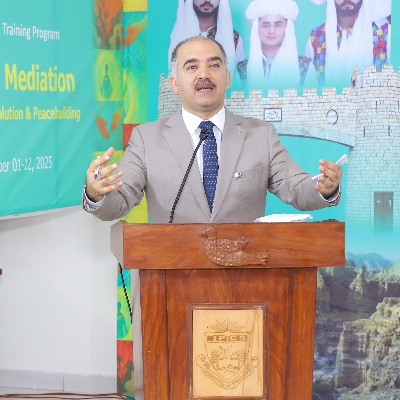
Dr. Jamil Ahmad
Professor
Institute of Peace and Conflict Studies | University of Peshawar
Professional Academic, Teaching, and Research Experience
Post-Doctoral Teaching and Research Experience
October 11, 2013 – January 4, 2026
Over 12 years of post-doctoral academic, research, and leadership experience in higher education, policy-oriented research, and institutional development.
Administrative and Leadership Positions
Director
May 2024 – Present
Institute of Peace and Conflict Studies, University of Peshawar, Pakistan
Project Director
June 2023 – April 2024
Pir Roshaan Institute of Progressive Sciences & Technologies, Miran Shah, North Waziristan
Public Sector Development Programme (PSDP) 2023–24, PKR 2 billion
Led the planning, coordination, and implementation of a large-scale public sector education and development project in a post-conflict region.
Director
May 2023 – June 2023
Institute of Peace and Conflict Studies, University of Peshawar, Pakistan
Director
September 2014 – July 2018
Institute of Peace and Conflict Studies, University of Peshawar, Pakistan
Provided strategic leadership in academic planning, faculty development, research expansion, and national and international collaborations.
National Observer
March 2017 – April 2017
United Nations Population Fund (UNFPA)
Served as a National Observer during the National Census of Pakistan, contributing to monitoring, data integrity, and compliance with international standards.
Deputy Director, Student Societies
June 2010 – December 2012
University of Peshawar, Pakistan
Oversaw student societies, extracurricular programming, leadership development initiatives, and institutional engagement activities.
Provincial Programme Officer
April 2000 – April 2001
Pakistan Red Crescent Society, Khyber Pakhtunkhwa
Managed provincial-level humanitarian and community-based programs, focusing on disaster response, coordination, and capacity building.
Project Director
May 2016 – July 2018
Establishment of the Institute of Peace and Conflict Studies, University of Peshawar
Led the conceptualization, infrastructure development, and institutionalization of the Institute.
Teaching, Research, and Academic Appointments
Professor
October 2015 – Present
Institute of Peace and Conflict Studies, University of Peshawar, Pakistan
Founding Editor-in-Chief
July 2015 – July 2018
Pakistan Journal of Peace and Conflict Studies (PJPCS)
Established and led the journal, overseeing editorial policy, peer-review processes, and academic standards.
Associate Professor, Social Anthropology
June 2014 – September 2014
University of Peshawar, Pakistan
Lecturer, Social Anthropology
May 2002 – June 2014
University of Peshawar, Pakistan
Kalasha Chair / Field Assistant
May 2006 – September 2008
Assisted Prof. Augusto Cacopardo in ethnographic research, including three months of intensive fieldwork (June–August 2006) among the Kalasha community.
Academic Qualifications & Research Experience
Post-Doctoral Fellow (Teaching)June 2015 – May 2016
Rio de Janeiro State University (UERJ), Rio de Janeiro, Brazil
Course: Gender, Schools, and Pakistani Culture (2 Credit Hours)
Supervisor: Prof. Carmen Lucia De Mattos
Completed a post-doctoral teaching fellowship followed by a nine-month distance research engagement, culminating in a joint academic publication (2016). The collaboration focused on gendered structures of violence within Pakistani school systems.
Selected Publication: Structure of Violence in Pakistani Schools: A Gender-Based Analysis In: Didática e Avaliação: Educação, Cidadania e Exclusão
Edited by Carmen Lucia Guimarães de Mattos, Luis Paulo Cruz Borges, Paula Almeida de Castro
Editora Realize, Campina Grande, Brazil
ISBN: 978-85-61702-39-7 | pp. 169–178
Doctor of Philosophy (PhD) in Sociology
December 2009 – October 2013
University of Peshawar, Pakistan
Dissertation Title:
Dynamics of Gender-Based Violence in Pakistani Schools: A Study of Selected Districts in Khyber Pakhtunkhwa
Supervisor: Prof. Anwar Alam
Doctoral research examined institutional, cultural, and structural dimensions of gender-based violence in educational settings, with a regional focus on Khyber Pakhtunkhwa.
Master of Arts (MA) in Anthropology
April 1997 – December 1999
University of Peshawar, Pakistan
Thesis Title:
Female Shelter Institutions in Pakistan
Supervisor: Prof. Rashid Khan
Research focused on state and non-state shelter systems, women’s protection mechanisms, and socio-cultural responses to gender-based vulnerability.
Bachelor of Arts (BA) in History & Islamic Studies
1994 – 1996
University of Peshawar, Pakistan
Other Academic Qualifications (Post-Graduate & Professional Training)
Post-Graduate Courses in Gender Studies
September 2008 – January 2009
Lund University, Sweden
Completed 30 ECTS credits in advanced gender studies, including:
- Social Science Theory
- Sexuality and Reproductive Health Rights
- Fieldwork Methods
Central Asian Studies (PhD Coursework)
September 2003 – June 2004
Area Study Center, University of Peshawar, Pakistan
Completed PhD-level coursework in Central Asian Studies with a CGPA of 3.4.
Research Ethics & Human Subjects Protection Certification
September 2011 – September 2014
Collaborative Institutional Training Initiative (CITI Program), Georgetown University, USA
Successfully completed and maintained certification in:
- Group 1: Biomedical Research Investigators and Key Personnel
- Group 3: Institutional Review Board (IRB) Members
Initially qualified on September 30, 2011, with certification refreshed on September 29, 2014.
Publications
- Zia, S., & Ahmad, J. (2025). Kinetic operations and heavy weapons in Pakistan’s counterterrorism: Effectiveness, limits, and civilian impact. Regional Lens, 4(4), 255–265.
- Khan, M. I., & Chitrali, J. A. (2025). Transformation of jirga and alternative dispute resolution mechanisms under militancy and state policies. Competitive Research Journal Archive, 3(3), 312–327.
- Fayyaz, R., & Chitrali, J. A. (2025). Post-conflict recovery and rehabilitation: An alternative psychosocial approach. Journal of Social Horizons, 2(2), 1–9.
- Javed, A., & Chitrali, J. A. (2025). Effectiveness of grievance redressal mechanism: Students’ perceptions at the University of Peshawar. International Journal of Social Sciences Bulletin, 3(9), 459–468.
- Cineen, K., & Chitrali, J. A. (2025). Media representation and public perceptions: The changing portrayal of Afghan refugees in Pakistan. Competitive Research Journal Archive, 3(3), 260–270.
- Salam, A., & Chitrali, J. A. (2025). Barriers to the enforcement of international humanitarian law in Afghanistan: Political, institutional, and legal challenges. Journal of Research Review, 2(3), 154–163.
- Fayyaz, R., & Chitrali, J. A. (2025). The survivors of political violence in Khyber Pakhtunkhwa and mental health care system through alternative treatment interventions. Qlantic Journal of Social Sciences and Humanities, 6(2), 20–31.
- Hassan, I., Mustafa, J., Ahmad, J., & Khalil, M. S. (2025). Peer mentoring in Pakistani secondary education: Benefits, mechanisms, and implementation challenges: A scoping review. Pakistan Journal of Social Science Review, 4(4), 515–527.
- Qureshi, H. H., Ahmad, J., & Ullah, Z. (2025). AI chatbots and the transformation of English learning in rural Pakistan: A socio-cultural and pedagogical perspective. Policy Journal of Social Science Review, 3(5), 373–785.
- Shah, S., & Ahmad, J. (2024). Navigating challenges: Resilience of women entrepreneurs in Khyber Pakhtunkhwa’s entrepreneurial ecosystem. CARC Research in Social Sciences, 3(3), 399–407.
- Shaukat, B., Ahmad, J., & Faheem, M. (2024). Assessing debate-centered pedagogies in promoting tolerance in higher education. Qlantic Journal of Social Sciences and Humanities, 5(4), 38–49.
- Ahmad, J., & Shaukat, B. (2023). From the culture of silence to the culture of expression: A meta-analysis. [Unpublished/Journal Article].
- Ahmad, J., Shoaib, M., & Shaukat, B. (2021). Academic library resources and services at higher education institutions during COVID-19 pandemic: A study of students’ satisfaction. Library Philosophy and Practice, 1–17.
- Ahmad, J., Ahmad, A., Shoaib, M., & Shaukat, B. (2021). Public library online information resources for patrons during COVID-19 pandemic: Evidence from higher education institutions. Library Philosophy and Practice, 1–14.
- Ahmad, J., & Ahmad, I. (2021). Quranic perspectives, scientific thought, and their contemporary applications. Journal of Islamic Civilization and Culture, 4(1), 1–9.
- Ahmad, J., & Ali, M. (2020). Occupational radiation exposures for medical workers in Pakistan – An overview. Polish Journal of Medical Physics and Engineering, 26(1), 45–53.
- Habib, H., & Ahmad, J. (2016). The effects of war on terror on Pakhtun nationalistic identity in Pakhtu poetry. Pakistan Journal of Peace and Conflict Studies, 1(1), 1–14.
- Sanauddin, N., Chitrali, J. A., & Owais, S. (2016). Public patriarchy: Women’s access to education, work, and politics in Pakistan. PUTAJ – Humanities & Social Sciences, 23(1).
- Chitrali, J. A., & Anwar, M. (2013). Socio-psychological consequences of spouse’s death on widows of Khyber Pakhtunkhwa. PUTAJ – Humanities & Social Sciences, 20.
- Chitrali, J. A., Anwar, M., & Nabahat, S. (2014). Structure of violence in Pakistani schools: A gender-based analysis. Pakistan Journal of Criminology, 6(2), 83.
- Chitrali, J. A., Anwar, M., & Nabahat, S. (2014). Dynamics of gender-based violence: Investigating effects of violence in Pakistani schools on dropout and creativity. Pakistan Journal of Criminology, 6(2), 133.
- Ahmad, J., Umar, M., Karim, S. S., Amaduddin, M., Akhtar, K., Shah, F., & Hussain, A. (2017). Design of a car wash wastewater treatment process for local car wash stations. Journal of the Pakistan Institute of Chemical Engineers, 45, 83–95.
- Ahmad, J., Khan, M., Waheed, M., Chengwen, H., & Butt, T. M. (2019). Development and perspectives of English as a language of instruction and learning in Chinese educational system. Asian Journal of Contemporary Education, 3(1), 28–35.