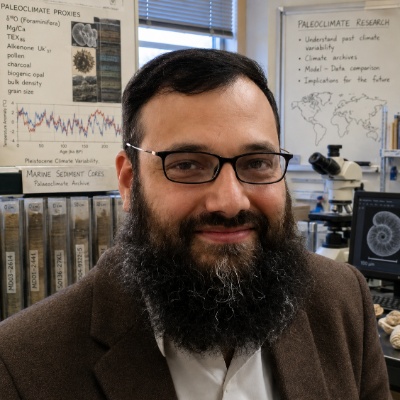
Mr. Muhammad Azhar Farooq Swati
Lecturer
Department of Geology | University of Peshawar
- About
- Education
- Professional Experience
- Teaching Profile
- Other Information
- Selected Publication
- Extended Publications
I developed my interest in stratigraphy, sedimentology, and micropalaeontology as they are extensively used in petroleum and mineral exploration along with the study of palaeoclimates within the earth's history. However, I am more attracted to the study of palaeoclimate. I am interested in the palaeoclimates of the Mesozoic-Cenozoic Era (250-33 million year ago) and intend to investigate it in depth to know it and better understand in terms of past climate, impact on terrestrial and marine life, its palaeoceanography, and palaeoceanographic circulation along with correlation to the other parts of the world. My current research focuses on the Palaeogene hyperthermal events, especially on the Palaeocene-Eocene (P-E) boundary interval. I use multiple integrated proxy approaches in stratigraphy, sedimentology, micropalaeontology, and geochemistry used in palaeoclimatology to address the issue stated.
|
Degree and Certificates |
Institution |
Year |
Main Subjects |
|
PhD (Geology) |
University of Peshawar, Peshawar, Pakistan |
2026 |
Stratigraphy and Sedimentology |
|
MPhil (Geology) |
University of Peshawar, Peshawar, Pakistan |
2016 |
Stratigraphy/Biostratigraphy |
|
M.Sc. Geology |
University of Peshawar, Peshawar, Pakistan |
2007 |
Geology |
|
B.Sc (Hon) Geology |
University of Peshawar, Peshawar, Pakistan |
2006 |
Geology |
- Working as a Lecturer in Geology, University of Peshawar, Pakistan since March, 2009.
I taught various courses to undergraduate students as well as postgraduate students. Currently, I am teaching the following courses to undergraduate students:
- 2nd Year BS-Geology Students: Stratigraphy
- 3rd Year BS-Geology Students: Micropalaeontology
- Coordinator for Hostel Affairs
5. Swati, M. A. F., & Hanif, M. (2025). Biostratigraphy, Microfacies, and Dynamics of the Early Eocene Dungan Formation, Pakistan: implications for the Ramp Evolution and Larger Foraminiferal Extinction and Origination Event (LFEO) Global Warming. Carbonates and Evaporites, 40(3), 119. doi:10.1007/s13146-025-01145-6
4. Swati, M.A.F., Hanif, M., Haneef, M., Saboor, A. (2021). Late Palaeocene to Early Eocene biostratigraphic framework from Upper Indus Basin Pakistan, Eastern Tethys. Geological Journal, 56: 3541–3556. https://doi.org/10.1002/gj.4114
3. Saboor, A., Ul Haq, M., Nawaz, A., Swati, M. A. F., Gohar, J., Khan, S., & Ghaffari, A. (2021). Insight to the geological character of the Early Triassic strata in the Western Salt Range, Pakistan: A comparative study. Geological Journal, 56(9), 4667-4684.
2. Hanif, M., Sabba, M., Ali, N., Rahman, M. U., Ali, F., Swati, M. A. F. (2020). A multi-proxy based high resolution stratigraphical analysis of the possible Palaeocene–Eocene boundary interval, Salt Range, Pakistan. Geological Journal. 1–23. https://doi.org/10.1002/gj.3912
1. Saboor, A., Haneef, M., Hanif, M., Swati, M. A. F. (2020). Sedimentological attributes of the Middle Jurassic peloids? dominated carbonates of eastern Tethys, lesser Himalayas, Pakistan. Carbonates and Evaporites, 35, 123-140. https://doi.org/10.1007/s13146-020-00662-w
7. Ahmad, S., Waqas, M., Khan, S. S., Swati, M. A. F., Jan, I. U., Ali, F., Yaqoob, M., Sadiq, A., Khan, S., & Ibad Ur, R. (2015). Facies analysis and dynamic depositional modelling of the upper permian chhidru formation, salt range, upper indus basin, Pakistan. Journal of Himalayan Earth Sciences, 48(1), 64-80.
6. Jamal, T., Azhar, R., Haneef, M., Saboor, A., Ali, N., Swati, M. A. F., & Uddin, Z. (2015). Microfacies and diagenetic fabric of the Chorgali Formation in Bhuchal Kalan, Kallar Kahar, Salt Range, Pakistan. Journal of Himalayan Earth Sciences, 48(1), 14-25.
5. Saboor, A., Ali, F., Ahmad, S., Haneef, M., Hanif, M., Imraz, M., Ali, N., Swati, M. A. F., Zahid, M., & Sadiq, I. (2015). A preliminary account of the middle Jurassic plays in Najafpur village, southeastern Hazara, Khyber Pakhtunkhwa, Pakistan. Journal of Himalayan Earth Sciences, 48(1), 41-49.
4. Khan, S., Ahmad, S., Hanif, M., Jan, I. U., Swati, M. A. F., Khan, S., & Saboor, A. (2014). Lithofacies , paleoenvironments and sequence stratigraphic modelling of the Wargal Limestone : Implication for reservoir characterization in the Salt Range, northwest, Pakistan. Journal of Himalayan Earth Sciences, 47(February), 41-60.
3. Sadiq, I., Ahmad, S., Hanif, M., Ali, F., Latif, K., Swati, M. A. F., Saboor, A., Hussain, H. S., Jan, I. U., & Ali, F. (2014). Implication of the diagenetic evolution for the diagnosis of reservoir potential of the amb formation, western salt range, Pakistan. Journal of Himalayan Earth Sciences, 47(2), 75-98.
2. Swati, M. A. F., Haneef, M., Ahmad, S., Latif, K., Naveed, Y., Zeb, W., Akhtar, N., & Owais, M. (2014). Diagenetic analysis of the early eocene margala hill limestone, Pakistan: A synthesis for thin section porosity. Journal of Himalayan Earth Sciences, 47(2), 49-61.
1. Swati, M. A. F., Haneef, M., Ahmad, S., Naveed, Y., Zeb, W., Akhtar, N., & Owais, M. (2013). Biostratigraphy and depositional environments of the Early Eocene Margalla Hill Limestone, Kohala-Bala area, Haripur, Hazara Fold-Thrust Belt, Pakistan. Journal of Himalayan Earth Sciences, 46(2), 65-77.